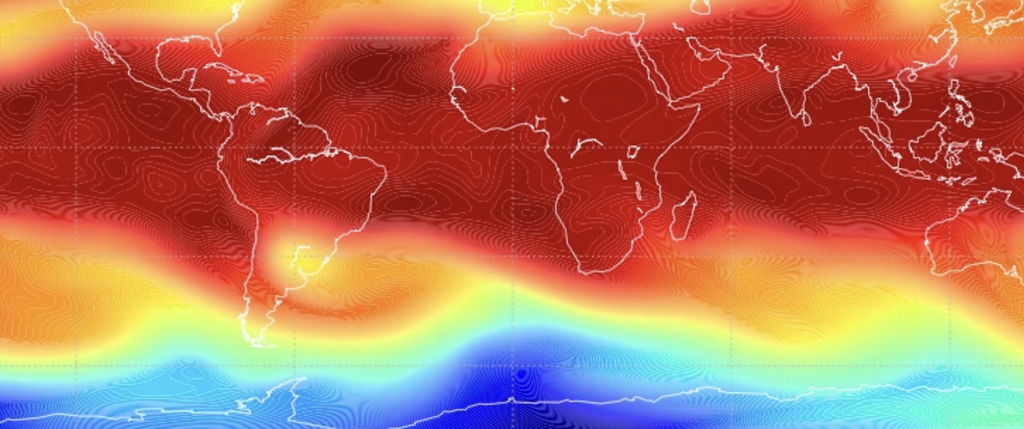
Computation has rapidly established itself alongside theory and experiment as the third pillar of the scientific method. Over recent decades, scientific simulations have grown from simple calculations with a few equations into massive models capturing complex physical processes. Too often, numerical analysts build elegant solvers for toy models while computational scientists rely on ad hoc methods with uncertain accuracy or stability. This research program bridges that divide by creating, applying, and sharing flexible algorithms tailored for modern multiphysics challenges without sacrificing mathematical rigor, accuracy, stability, or parallel scalability.
Computation as the Third Pillar of Modern Science
Scientific discovery increasingly depends on large-scale numerical models that unite multiple physical phenomena in a single simulation. As physical systems grow more intricate, standard mathematical analysis alone frequently struggles to keep pace.
- Theory: Provides foundational principles, structural insight, and formal guarantees for mathematical models.
- Experiment: Observes real-world physical behavior and supplies empirical benchmarks for validation.
- Computation: Enables high-resolution simulations of coupled, large-scale systems that are difficult or impossible to study analytically or in a lab alone.
Closing the Gap Between Numerical Analysis and Simulation
When mathematical theory and simulation practice drift apart, both sides face clear limitations. Aligning them requires numerical methods that remain practical for realistic applications while preserving dependable mathematical properties.
| Dimension | Theory-Focused Solvers | Ad Hoc Simulation Methods | Balanced Multiphysics Algorithms |
| Target Systems | Simplified models with limited practical reach | Highly realistic, multi-process physical systems | Modern, complex multiphysics problems |
| Accuracy & Stability | Well-understood mathematically | Often questionable or unverified | Grounded in mathematical assurances |
| Adaptability | Often rigid and idealized | Case-specific workarounds | Flexible and tunable to problem structure |
| Parallel Scalability | Not always a primary focus | Varies widely by implementation | Designed for parallel performance |
Core Pillars of the Research Program
The research agenda centers on turning rigorous numerical ideas into dependable computational tools for scientists and engineers:
- Algorithm Creation: Designing flexible numerical methods capable of handling coupled physical processes.
- Practical Application: Deploying solvers on realistic scientific simulations where accuracy and stability matter.
- Software Dissemination: Sharing algorithms and tools broadly so researchers can apply them in practice.
- Mathematical Assurances: Preserving core guarantees—including accuracy, stability, and parallel scalability—across demanding workloads.
Courses, Teaching, and Academic Schedule
Graduate instruction and mentoring form a core part of ongoing academic work, combining rigorous numerical foundations with hands-on problem solving.
- Course Focus: MATH 6321 covers the numerical solution of ordinary differential equations (ODEs).
- Class Schedule: Meets Tuesdays and Thursdays from 2:00 PM to 3:20 PM in Umphrey Lee Hall, Room 228.
- Office Hours: Available Tuesdays and Thursdays from 12:30 PM to 1:50 PM, Wednesdays from 2:00 PM to 3:00 PM, or by email appointment.
Research Areas, Software, and Academic Contact
Collaboration across research groups, open numerical software, and published scholarship helps translate mathematical methods into everyday scientific computing.
| Resource / Channel | Details |
| Site Sections | Home, Research, Publications, Teaching, Software, Research Team, Contact |
| [email protected] | |
| Phone | +1-214-768-4339 |
| ORCID | 000-0002-0911-7841 |
Advancing Reliable Multiphysics Computing
Modern scientific simulations demand numerical methods that are both adaptable to complex physical models and mathematically trustworthy. By uniting theoretical analysis with practical algorithm design, application, and dissemination, this work addresses the disconnect between idealized solvers and ad hoc large-scale simulations. Each numerical approach is shaped to support accuracy, stability, and parallel scalability as scientific models continue to grow in scope and realism. Alongside active research, structured coursework in numerical ODEs and accessible academic channels support students, collaborators, and fellow researchers exploring computational and applied mathematics. Together, these efforts advance dependable simulation tools for modern science.
Frequently Asked Questions
What is the main goal of Daniel R. Reynolds’s research program?
The research program aims to bridge mathematical theory and scientific computing practice by developing, applying, and sharing tunable multiphysics algorithms that preserve accuracy, stability, and parallel scalability.
Why does the page highlight a gap between numerical analysis and scientific simulation?
Because applied mathematics has evolved more slowly than large-scale physical simulations, leaving theoretical solvers focused on simpler models while realistic simulations sometimes rely on ad hoc methods with uncertain accuracy or stability.
How is computation positioned within the scientific method?
Computation serves as the third pillar of the scientific method alongside theory and experiment to model complex, multi-process physical systems.
What course and office hours are listed on the page?
The page lists MATH 6321 (Numerical Solution of ODEs) on Tuesdays and Thursdays from 2:00 PM to 3:20 PM in Umphrey Lee Hall room 228, with office hours on Tuesdays and Thursdays from 12:30 PM to 1:50 PM, Wednesdays from 2:00 PM to 3:00 PM, or by email appointment.
How can visitors contact Daniel R. Reynolds or explore other sections of the site?
Visitors can reach out via email at [email protected], phone at +1-214-768-4339, or ORCID 000-0002-0911-7841, and navigate to Research, Publications, Teaching, Software, Research Team, or Contact.